Developing a new technology is not, in itself, a guarantee that it will improve the daily lives of patients or healthcare professionals. The true success of healthcare innovation lies in its ability to become part of routine clinical practice and deliver measurable value.
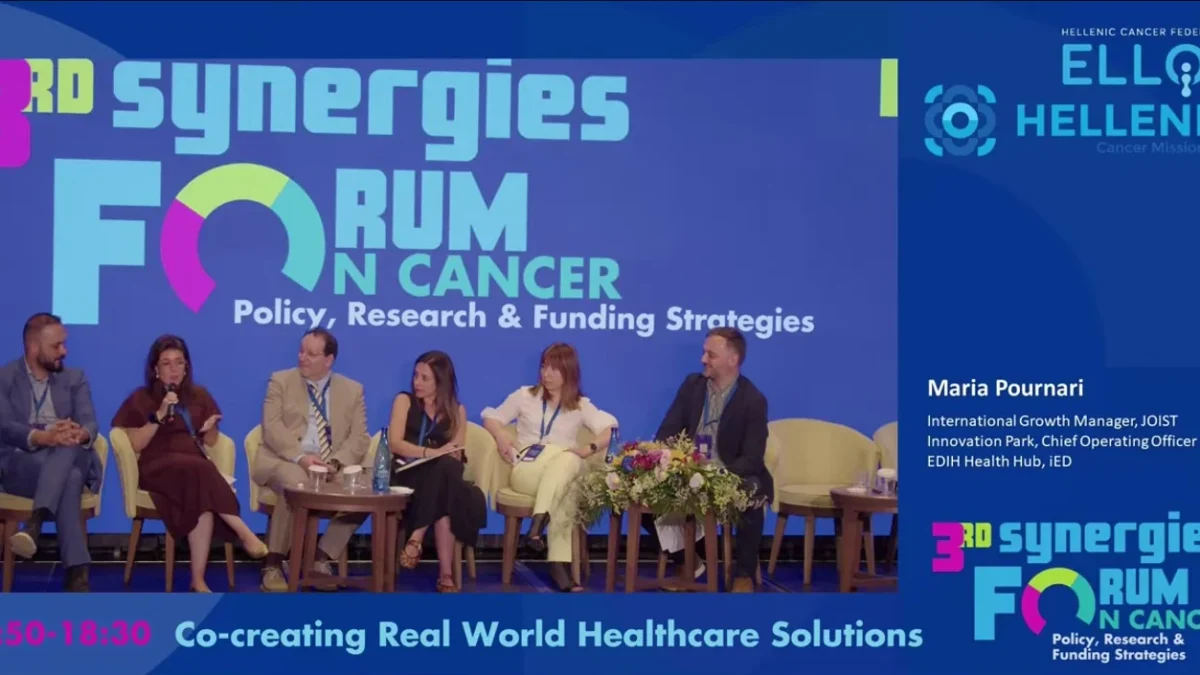
This was the central message of the “Co-creating Real World Healthcare Solutions” panel discussion at the 3rd Synergies Forum on Cancer, where representatives from research, industry, healthcare organisations and the innovation ecosystem explored how promising ideas can successfully transition from development to real-world implementation.
Innovation Starts with Real Needs
One of the strongest messages to emerge from the discussion was that the success of an innovative solution depends on far more than the technology behind it. For innovation to make a meaningful difference, it must be designed from the outset with the active involvement of those who will ultimately use it or benefit from it, including patients, healthcare professionals and healthcare providers.
Co-creation is therefore not simply a desirable approach but a prerequisite for developing solutions that address genuine healthcare needs and can be successfully integrated into clinical practice. As Maria Pournari, Chief Operations Officer of Health Hub, highlighted during the discussion, “when we design solutions for patients, we cannot do it without involving them.”
The Greatest Challenge Comes After Development
While healthcare technologies continue to evolve rapidly, the panellists agreed that the most difficult stage begins after a solution has been developed.
Regulatory compliance, user training and ensuring long-term adoption beyond the lifetime of a research project often prove more challenging than the technological development itself. Success is not measured by the completion of a pilot project, but by whether a solution continues to be used, evolves over time and delivers value years after its initial deployment.
Artificial Intelligence Needs Trust
Artificial intelligence was another key topic throughout the discussion.
The panel highlighted AI’s growing role in supporting healthcare professionals while emphasising that it should never replace clinical judgement or the relationship between clinicians and patients. According to the speakers, successful AI adoption in healthcare depends not only on the accuracy of algorithms, but also on healthcare professionals understanding how these tools work, trusting their outputs and retaining responsibility for clinical decision-making.
Health Hub’s Role: Turning Individual Initiatives into Meaningful Collaboration
A recurring conclusion throughout the discussion was that healthcare innovation cannot thrive through isolated initiatives. Meaningful collaboration between all stakeholders is essential for transforming promising ideas into solutions that can be successfully implemented in real healthcare settings.
Maria Pournari also stressed that success should no longer be measured by the number of events or initiatives delivered, but by the tangible outcomes they generate. Referring, among other examples, to Health Hub’s recent participation at Panathēnea, she explained that the Hub’s objective is for every initiative to create real value for the organisations and professionals involved.
As the European Digital Innovation Hub for Health and Pharmaceuticals in Greece, Health Hub acts as a bridge between businesses, healthcare organisations, research institutions and public authorities. By facilitating collaboration across the ecosystem, it supports the development, testing and adoption of digital health solutions that address real-world healthcare challenges. Learn more about Health Hub’s services here.